by Daniel Brouse and Sidd Mukherjee
July 2026
For the math, visit:
When I began this journey more than three decades ago, I wasn’t a climate researcher. I was a financial planner specializing in business, economics, estate planning, and risk management. My academic background included economics, philosophy, and extensive study in physics, calculus, statistics, and systems analysis. My career focused on a simple question:
How do you create the best possible future for the people who come after you?
In the early 1990s, I met a brilliant scientist named Sidd. We shared a curiosity about complex systems and a desire to test ideas rather than simply debate them. Together, we began an experiment that has now spanned more than thirty years.
Our goal was unusual. We wanted to build what we jokingly called a one-size-fits-all, bulletproof shareware estate plan—not for one family, but for every family on Earth.
At the same time, I was helping pioneer some of the earliest privately owned web servers. Before commercial hosting became commonplace, we were operating online while many organizations were still connected through universities. It was the same era when Yahoo! itself was running from Stanford University.
By 1995, our website, KingArthur.com, was attracting millions of visitors each month. The internet gave us something few researchers had ever possessed: the ability to interact directly with millions of people across cultures, countries, religions, and generations.
One question became central to our experiment:
“When it comes to your life and what you leave behind, what is the single most important thing?”
We expected many people to answer with wealth, success, fame, or legacy.
Instead, they overwhelmingly answered something much simpler.
Among people under fifty, the most common answer was their children.
Among those over fifty, the answer shifted to their grandchildren.
The experiment revealed something profound. The greatest wealth most people hope to preserve is not money. It is the opportunity for future generations to experience the same joys they have experienced themselves.
In other words, the ultimate estate plan is remarkably simple:
To my children’s children’s children.
The greatest inheritance most of us hope to leave is not a larger bank account. It is the chance for our descendants to raise children of their own, watch them grow, and someday become grandparents themselves.
When we began this experiment, I did not have grandchildren.
Today I do.
That changes everything.
Coincidentally, I was recently asked a question that perfectly captured the purpose of this work:
“Can you play with me on this? I’m wearing my nutritional ecologist hat here, and I’m in a municipal-level discussion that is trying to zoom out seven generations while also identifying the baby steps needed over the next four-year election cycle.”
My immediate thought was:
Exactly.
That is what this experiment has always been about.
An estate plan should not end with our children—or even our grandchildren. It should extend seven generations into the future.
My grandchildren deserve the opportunity to become grandparents themselves. Their grandchildren deserve the same opportunity.
That is entirely achievable—but only if we make wise decisions today.
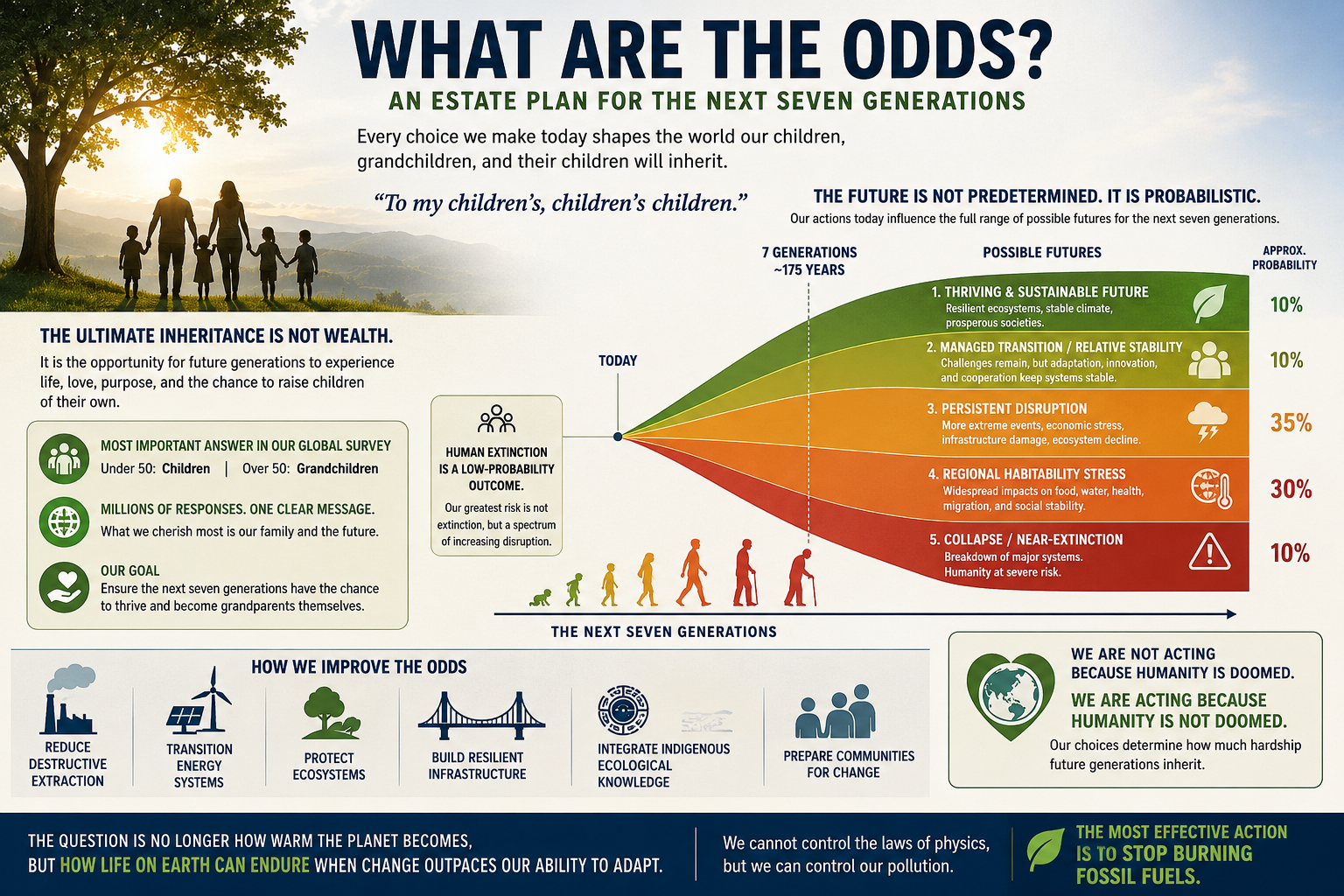
The graph that follows illustrates that idea.
Every choice we make now influences the range of possible futures available to the next seven generations.
Some outcomes are relatively optimistic. Some involve increasing climate disruption.
Some are far more severe.
Importantly, human extinction remains a low-probability outcome.
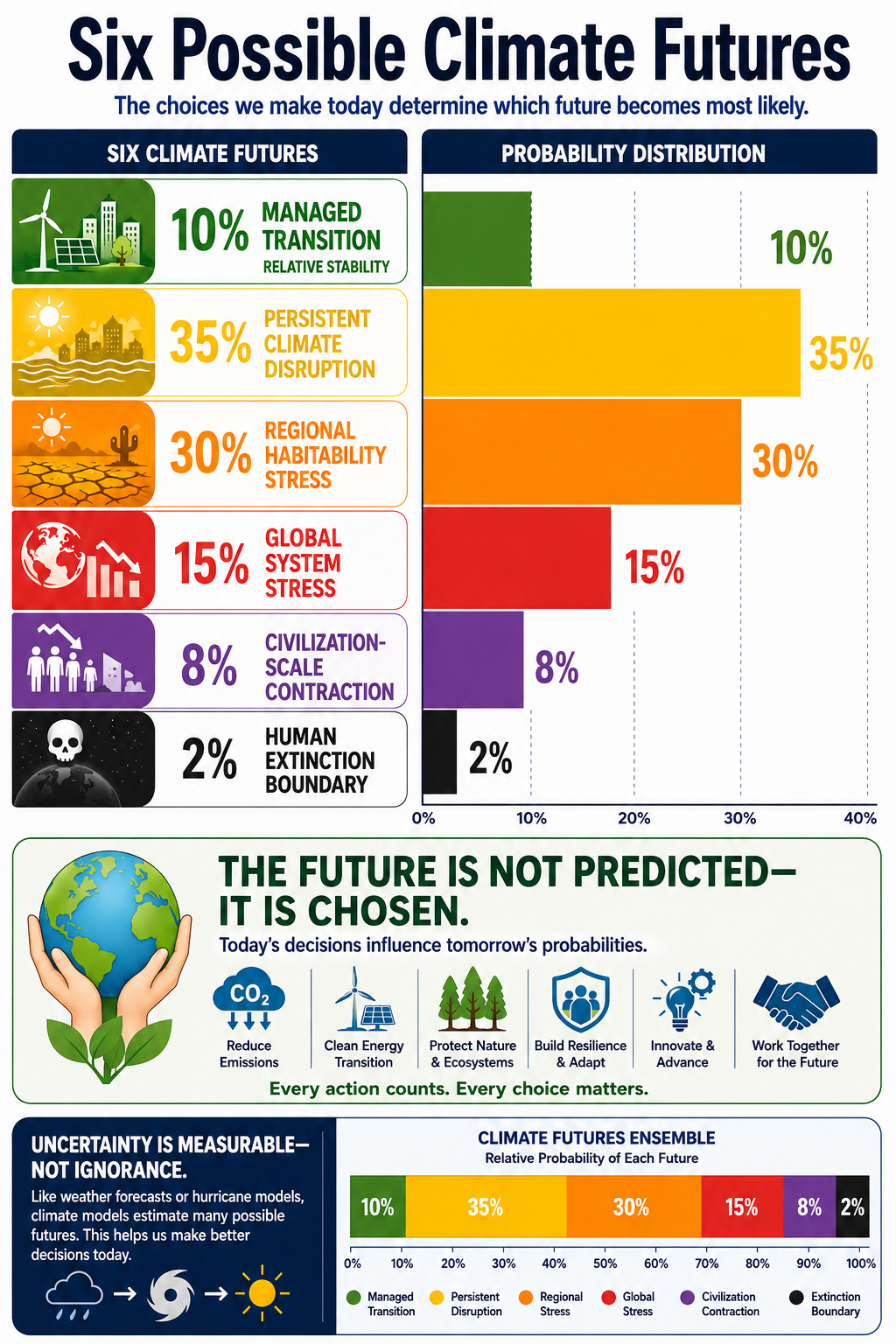
The far more likely future is not one of sudden extinction, but one that spans a spectrum of increasing disruption—affecting ecosystems, agriculture, infrastructure, economies, public health, migration, and regional habitability.
The probabilities are not fixed. They are shaped by the decisions humanity makes over the coming decades.. including today.
That changes the conversation entirely.
The question is no longer:
“Are humans going extinct?”
The more important question is:
“How difficult do we want life to be for the next seven generations?”
That question naturally leads to practical priorities:
The most important message is this:
We are not acting because humanity is doomed.
We are acting because humanity is not doomed.
Our choices today determine how much hardship future generations inherit.
Ultimately, this is not simply a discussion about climate change.
It is an estate planning exercise on a planetary scale.
The question is no longer how warm the planet becomes.
The question is how well civilization—and the generations that follow us—can endure as environmental change accelerates faster than our ability to adapt.
We cannot rewrite the laws of physics. But we can decide how much pollution we continue to add to the atmosphere.
The most effective steps you can take is also the simplest:
1) Stop burning fossil fuels as quickly and responsibly as possible, while building a more resilient world for the generations that follow.
For the math, visit:
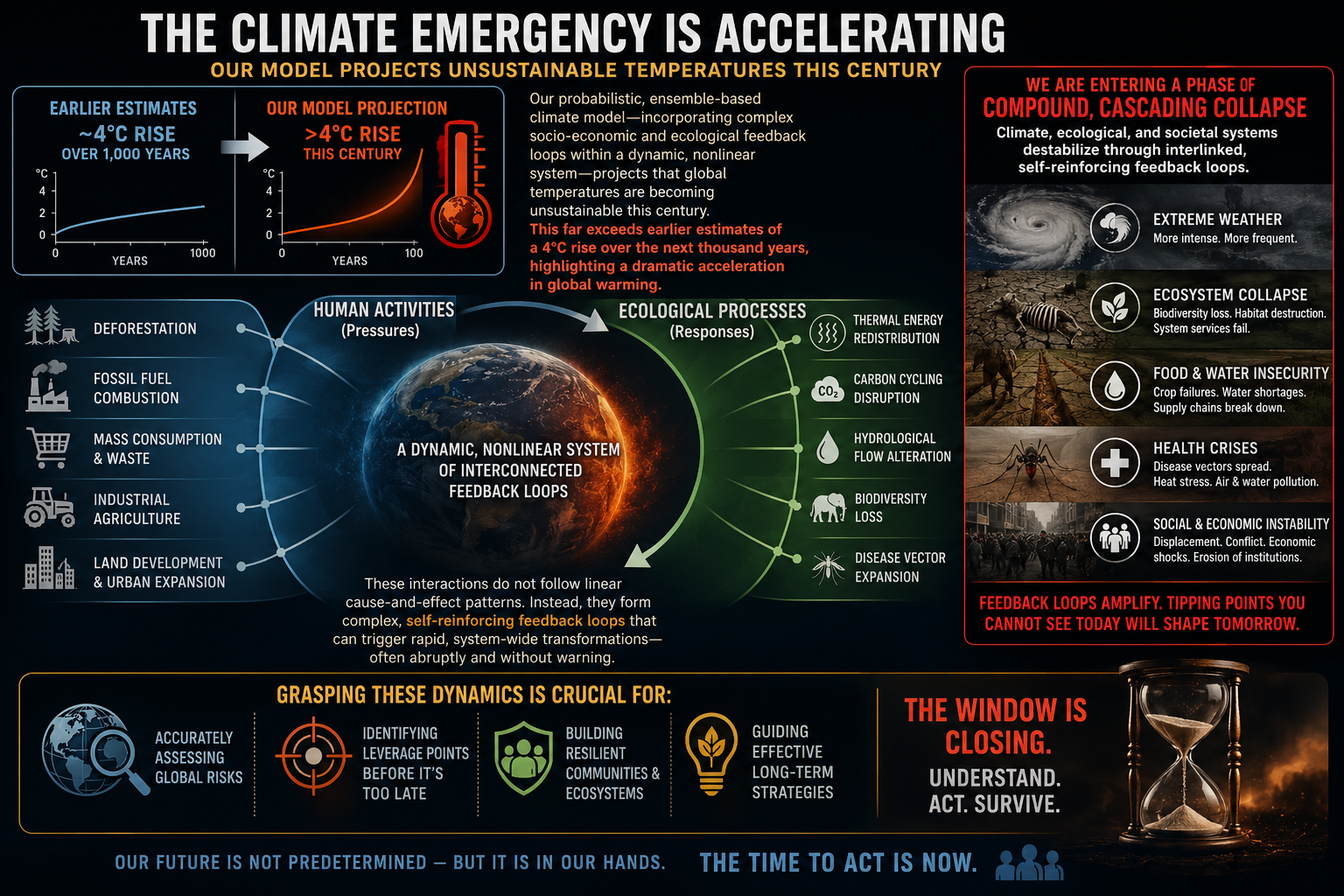
* Our probabilistic, ensemble-based climate model — which incorporates complex socio-economic and ecological feedback loops within a dynamic, nonlinear system — projects that global temperatures are becoming unsustainable this century. This far exceeds earlier estimates of a 4°C rise over the next thousand years, highlighting a dramatic acceleration in global warming. We are now entering a phase of compound, cascading collapse, where climate, ecological, and societal systems destabilize through interlinked, self-reinforcing feedback loops.
We examine how human activities — such as deforestation, fossil fuel combustion, mass consumption, industrial agriculture, and land development — interact with ecological processes like thermal energy redistribution, carbon cycling, hydrological flow, biodiversity loss, and the spread of disease vectors. These interactions do not follow linear cause-and-effect patterns. Instead, they form complex, self-reinforcing feedback loops that can trigger rapid, system-wide transformations — often abruptly and without warning. Grasping these dynamics is crucial for accurately assessing global risks and developing effective strategies for long-term survival.
Bottom line: The question is no longer how warm the planet becomes, but how life on Earth can endure when change outpaces our ability to adapt.
We cannot control the laws of physics, but we can control our pollution. The most effective action is to stop burning fossil fuels.