by Daniel Brouse
July 2026
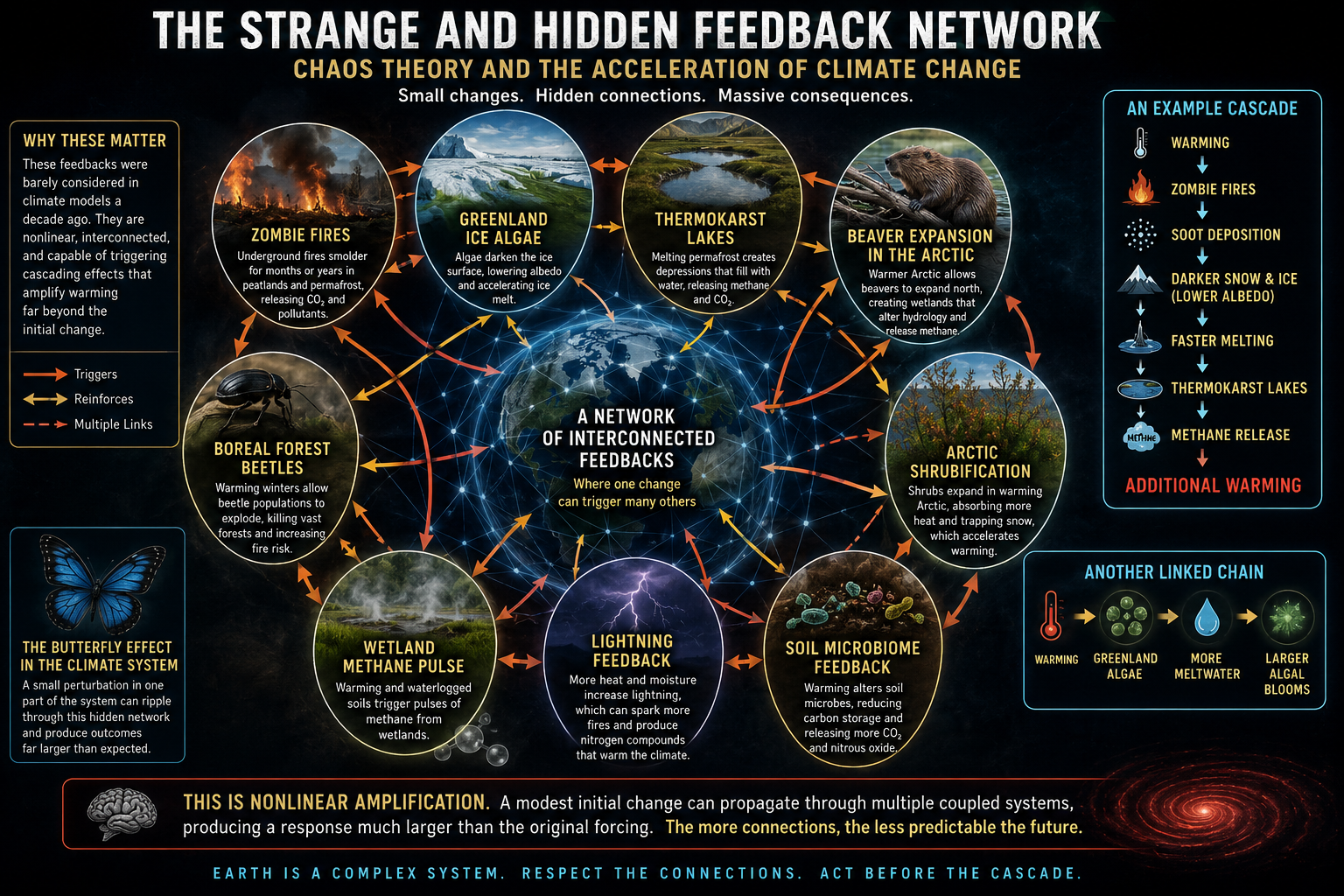
Some of the most fascinating—and concerning—climate feedback loops are ones that were barely considered in climate models a decade ago. They illustrate how a relatively small change can trigger a cascade of nonlinear responses, making them particularly relevant from a chaos theory perspective.
Feedback loop:
These fires can survive beneath snow because peat acts like charcoal, insulating the combustion. They’re becoming increasingly common across Canada and Siberia as warmer, drier conditions expand.
Perhaps one of the strangest biological feedbacks.
Feedback loop:
Researchers call this biological darkening. In parts of Greenland’s “Dark Zone,” algae have become a measurable contributor to increased melt.
One of the least intuitive feedbacks.
Feedback loop:
Small lakes become “hot spots” that can emit disproportionately large amounts of methane.
As northern regions warm:
An animal once considered ecologically beneficial in temperate regions becomes an unexpected amplifier of Arctic warming.
Cold winters historically killed bark beetles.
Now:
Smoke doesn’t just affect air quality.
Wildfire ash and black carbon settle on:
This lowers albedo, causing earlier melt, which exposes darker land and ocean surfaces that absorb even more solar energy.
As tundra warms:
A simple change in vegetation alters the thermal properties of the landscape.
Increasing winter rain instead of snow causes:
This feedback connects winter weather directly to summer fire seasons.
Marine heat waves can eliminate kelp forests.
Loss of kelp means:
Warmer surface oceans become lighter.
This reduces vertical mixing.
Consequences include:
Heavy rainfall creates:
Ironically, wetter conditions can increase greenhouse-gas emissions from wetlands.
As glaciers melt:
Greenland exhibits this effect over large areas.
Greenland meltwater freshens the North Atlantic.
Fresh water is less dense, reducing deep-water formation.
This can alter ocean circulation, redistribute heat, and change regional weather patterns. Some studies suggest this may also increase subsurface warming near marine-terminating glaciers, enhancing ice-sheet melt.
Warmer air produces:
Recent studies indicate lightning activity is increasing in parts of the Arctic, where lightning was historically uncommon.
Warmer soils stimulate microbial activity.
Microbes decompose organic matter faster, releasing:
These gases further warm the atmosphere, increasing microbial activity even more.
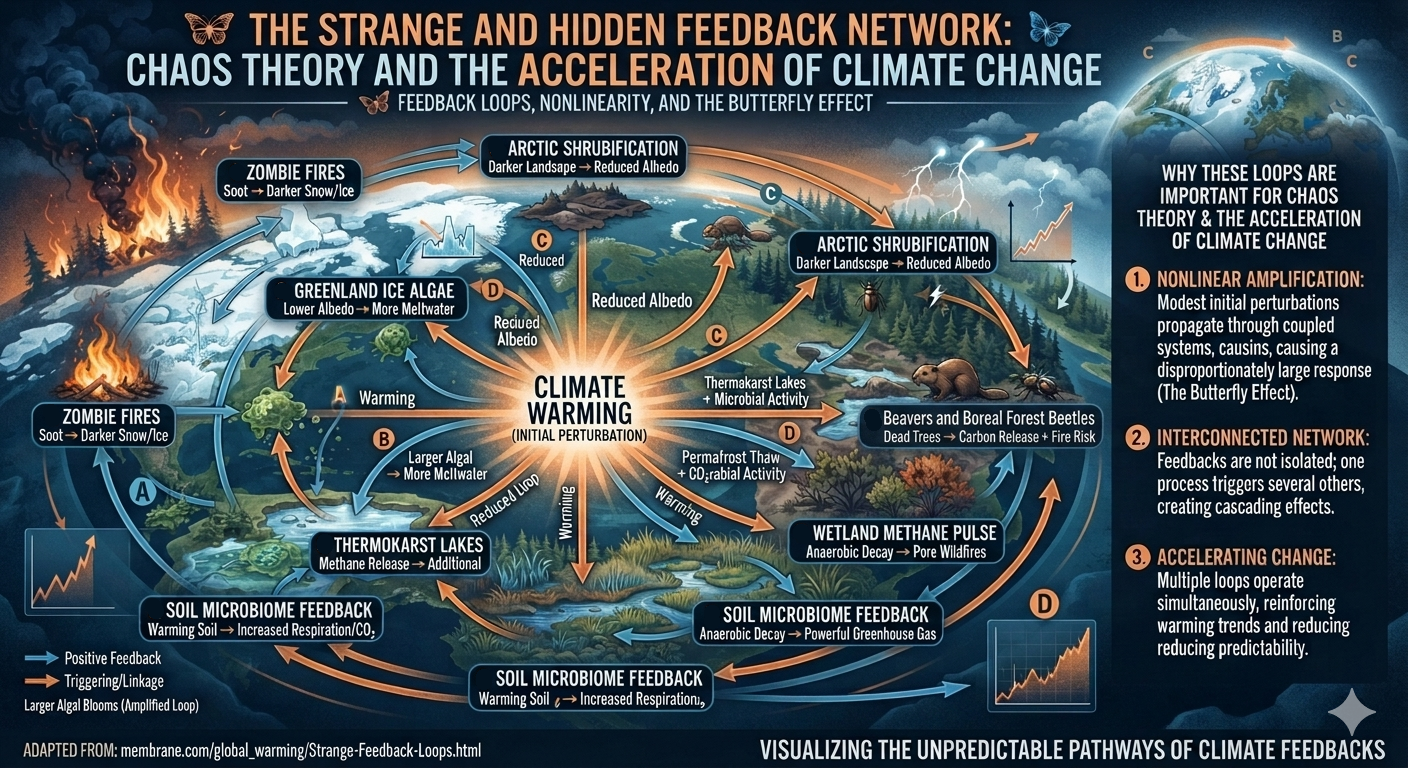
What’s striking is that these feedbacks don’t operate independently. They form an interconnected network in which one process often triggers several others. For example:
Likewise:
These interactions exemplify nonlinear amplification: a modest initial perturbation can propagate through multiple coupled systems, producing a response much larger than the original forcing (The Butterfly Effect). That networked behavior is one reason Earth-system responses can become increasingly difficult to predict with linear cause-and-effect thinking.
Bottom line: The question is no longer how warm the planet becomes, but how life on Earth can endure when change outpaces our ability to adapt.
We cannot control the laws of physics, but we can control our pollution. The most effective action is to stop burning fossil fuels.
* Our probabilistic, ensemble-based climate model — which incorporates complex socio-economic and ecological feedback loops within a dynamic, nonlinear system — projects that global temperatures are becoming unsustainable this century. This far exceeds earlier estimates of a 4°C rise over the next thousand years, highlighting a dramatic acceleration in global warming. We are now entering a phase of compound, cascading collapse, where climate, ecological, and societal systems destabilize through interlinked, self-reinforcing feedback loops.
We examine how human activities — such as deforestation, fossil fuel combustion, mass consumption, industrial agriculture, and land development — interact with ecological processes like thermal energy redistribution, carbon cycling, hydrological flow, biodiversity loss, and the spread of disease vectors. These interactions do not follow linear cause-and-effect patterns. Instead, they form complex, self-reinforcing feedback loops that can trigger rapid, system-wide transformations — often abruptly and without warning. Grasping these dynamics is crucial for accurately assessing global risks and developing effective strategies for long-term survival.
Feedback Loops →
Tipping Points →
Acceleration →
Domino Effect
Feedback loops amplify climate change and can push interconnected Earth systems past critical tipping points. As tipping points are crossed, they can trigger additional feedback loops and destabilize other climate systems. This cascading "Domino Effect" compresses timescales, accelerates change, and increases the risk of rapid, nonlinear climate transformations.