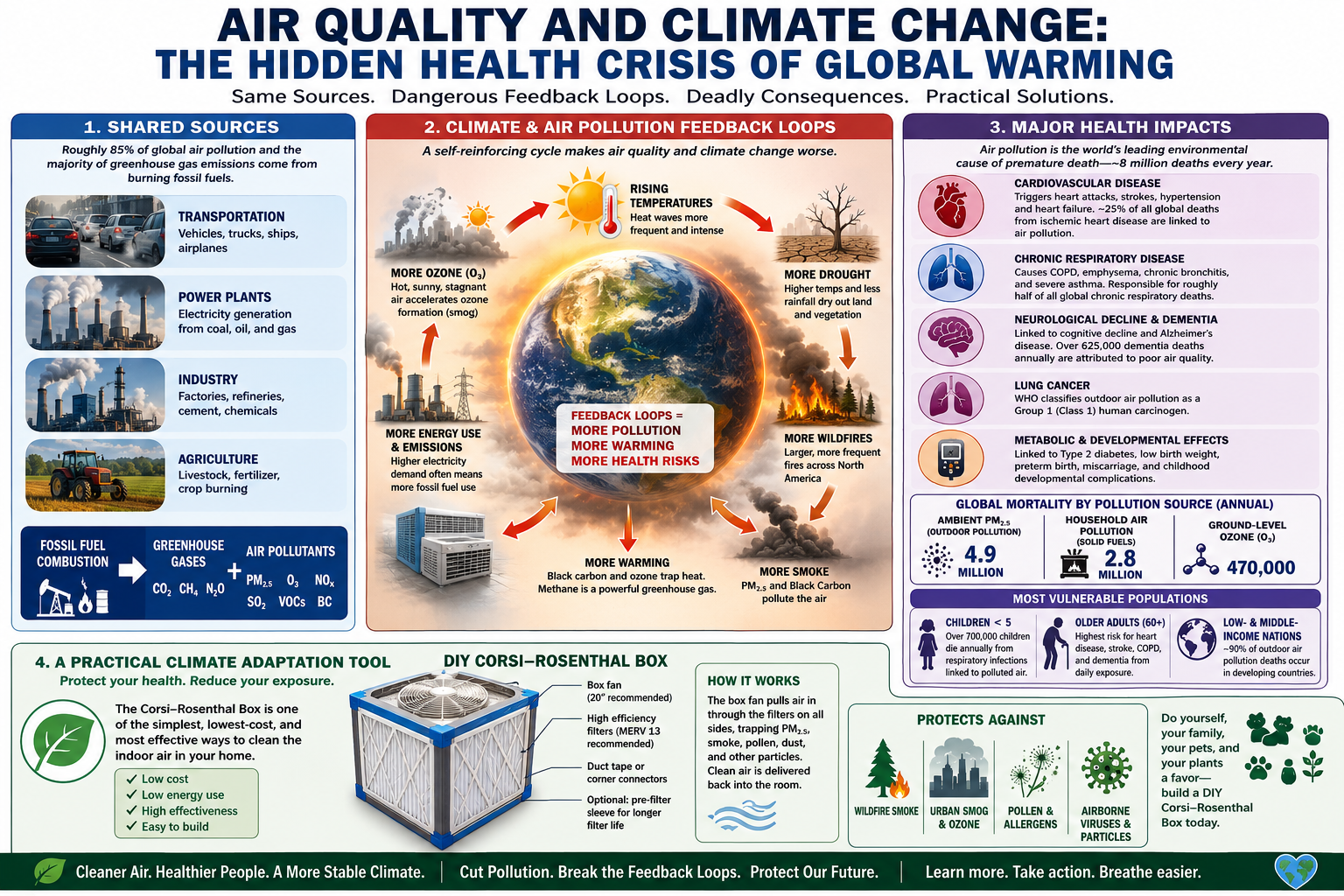
Air pollution and climate change are deeply interconnected because both are driven primarily by the combustion of fossil fuels. Many of the same pollutants that degrade local air quality—including ground-level ozone (O₃), methane (CH₄), and black carbon (soot)—also act as powerful climate forcers that accelerate global warming.
The relationship is bidirectional: climate change worsens air pollution, while air pollution further accelerates climate change through multiple reinforcing feedback loops.
Approximately 85% of global air pollution and the majority of greenhouse gas emissions originate from burning fossil fuels for transportation, electricity generation, industry, and agriculture. Reducing fossil fuel consumption therefore provides one of the greatest opportunities to improve both climate stability and public health simultaneously.
As temperatures rise, air quality deteriorates through several mechanisms:
Air pollution is the leading environmental risk factor for premature death. Each year, exposure to polluted air contributes to an estimated 7.9–8.1 million premature deaths worldwide—approximately one out of every eight deaths globally. This exceeds the annual mortality attributed to tobacco use.
Nearly 90% of this health burden results from chronic noncommunicable diseases that are either caused or worsened by long-term exposure to polluted air.
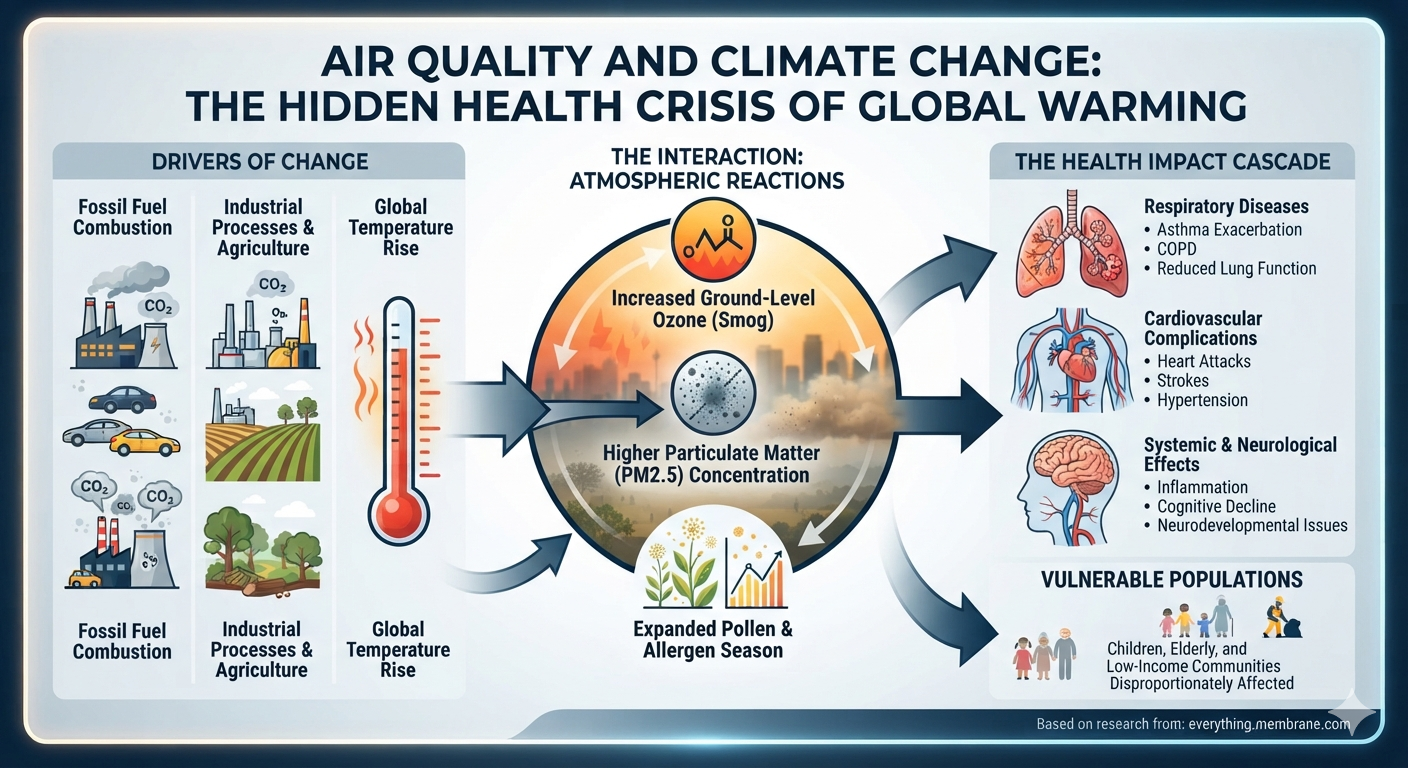
Microscopic pollutants, particularly fine particulate matter (PM₂.₅), penetrate deep into the lungs and enter the bloodstream, triggering widespread inflammation throughout the body.
Air pollution significantly increases the risk of heart attacks, strokes, hypertension, and heart failure. Approximately one-quarter of all global deaths from ischemic heart disease are linked to polluted air.
Long-term exposure contributes directly to:
Air pollution accounts for roughly half of all deaths from chronic respiratory diseases worldwide.
Growing evidence links chronic air pollution exposure to cognitive decline, Alzheimer’s disease, and other forms of dementia. Recent global estimates attribute more than 625,000 dementia-related deaths annually to poor air quality.
The World Health Organization classifies outdoor air pollution as a Group 1 (Class 1) human carcinogen, the same highest-risk category used for tobacco smoke and asbestos. Long-term exposure substantially increases the risk of lung cancer.
Research also links air pollution to:
Most pollution-related deaths result from three primary exposure pathways:
| Source | Estimated Annual Deaths |
|---|---|
| Ambient PM₂.₅ (outdoor pollution) | 4.9 million |
| Household air pollution (solid fuels) | 2.8 million |
| Ground-level ozone (O₃) | 470,000 |
Together, these exposure pathways account for approximately 8 million premature deaths every year.
The health burden of air pollution is not evenly distributed.
More than 700,000 children under age five die annually from respiratory infections associated with polluted air, making air pollution the second-leading environmental risk factor for early childhood mortality.
Adults over age 60 experience the highest rates of pollution-related cardiovascular disease, respiratory illness, stroke, and dementia.
Approximately 90% of outdoor air pollution deaths occur in developing nations, where rapid industrialization, heavy reliance on fossil fuels, and limited access to healthcare combine to create disproportionate health risks.
Air pollution is not merely a consequence of climate change—it also reinforces it.
Several important feedback loops illustrate this interaction:
Fossil Fuel Combustion → Greenhouse Gas Emissions → Global Warming → More Wildfires → More Smoke (PM₂.₅ and Black Carbon) → Additional Atmospheric Heating
Global Warming → Higher Temperatures → Increased Ground-Level Ozone → Poorer Air Quality → Greater Public Health Impacts
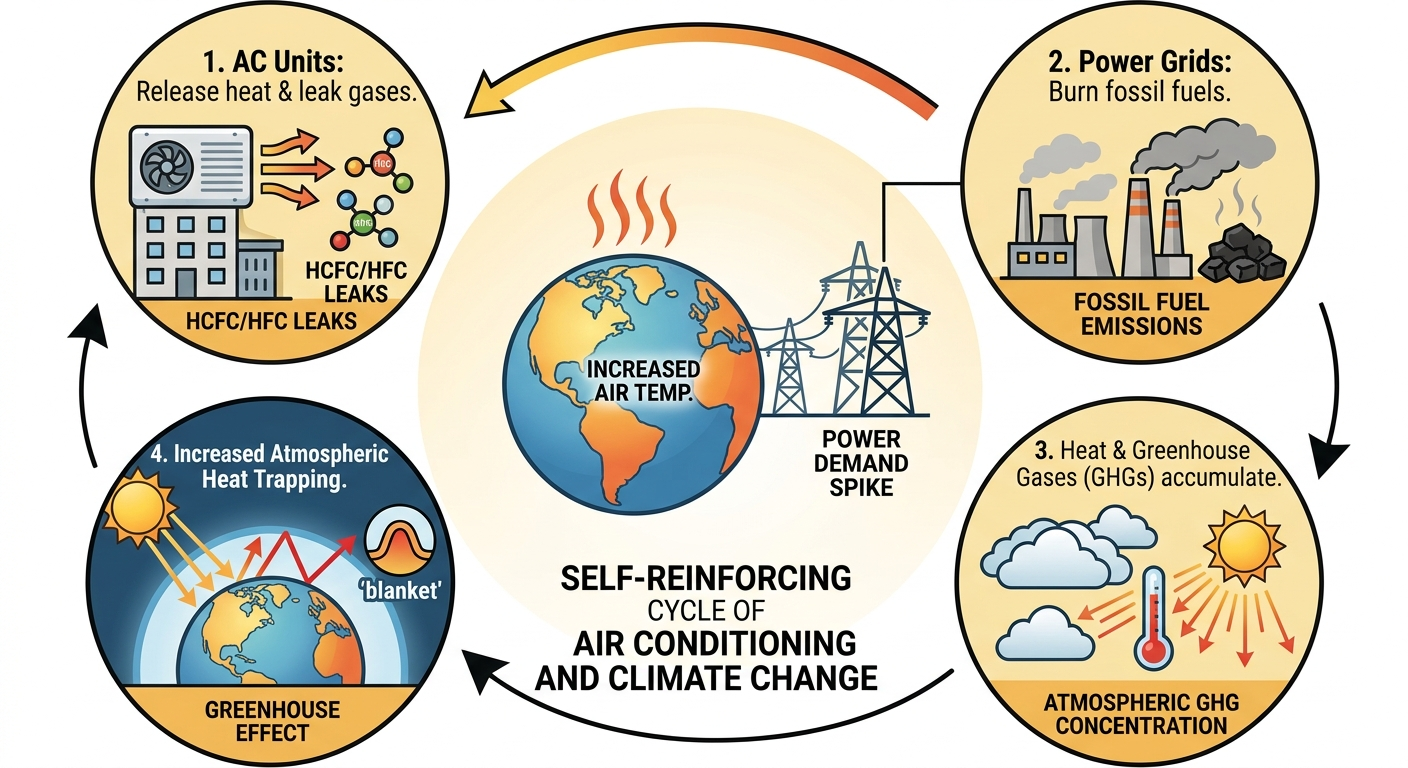
Extreme Heat → Increased Air Conditioning Demand → Higher Electricity Consumption → Greater Fossil Fuel Use (where grids remain carbon-intensive) → More Greenhouse Gas Emissions → Additional Warming
These reinforcing cycles demonstrate why improving air quality is also an effective climate mitigation strategy.
While reducing greenhouse gas emissions remains essential, individuals can take practical steps to reduce their exposure to worsening air pollution.
One of the simplest, least expensive, and most effective indoor air filtration systems is the Corsi–Rosenthal Box.
Constructed from four or five high-efficiency furnace filters and a standard box fan, a Corsi–Rosenthal Box can remove large amounts of smoke, dust, pollen, and airborne particulate matter at a fraction of the cost of commercial air purifiers.
Its energy efficiency is particularly important because it helps improve indoor air quality without significantly increasing electricity demand. This is especially valuable as climate change drives greater air-conditioning use, creating another reinforcing feedback loop:
More Heat → More Air Conditioning → Greater Energy Demand → More Greenhouse Gas Emissions (where electricity is fossil-fuel based) → Additional Warming
A Corsi–Rosenthal Box helps break part of this cycle by providing highly effective air filtration using very little electricity.
Whether you’re protecting yourself from wildfire smoke, urban smog, allergens, or airborne viruses, it is one of the most cost-effective climate adaptation tools available.
Do yourself, your family, your pets, and even your houseplants a favor—build a DIY Corsi–Rosenthal Box.
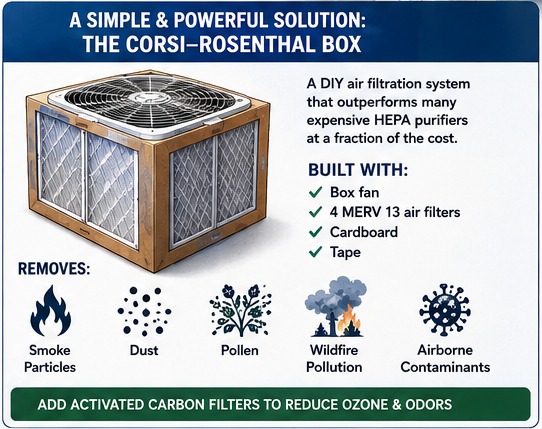
All you need is a box fan and some furnace filters. You can start with just one filter placed behind the fan; you don’t even need tape because the fan’s suction holds the filter securely in place.
Corsi–Rosenthal Box Instructions
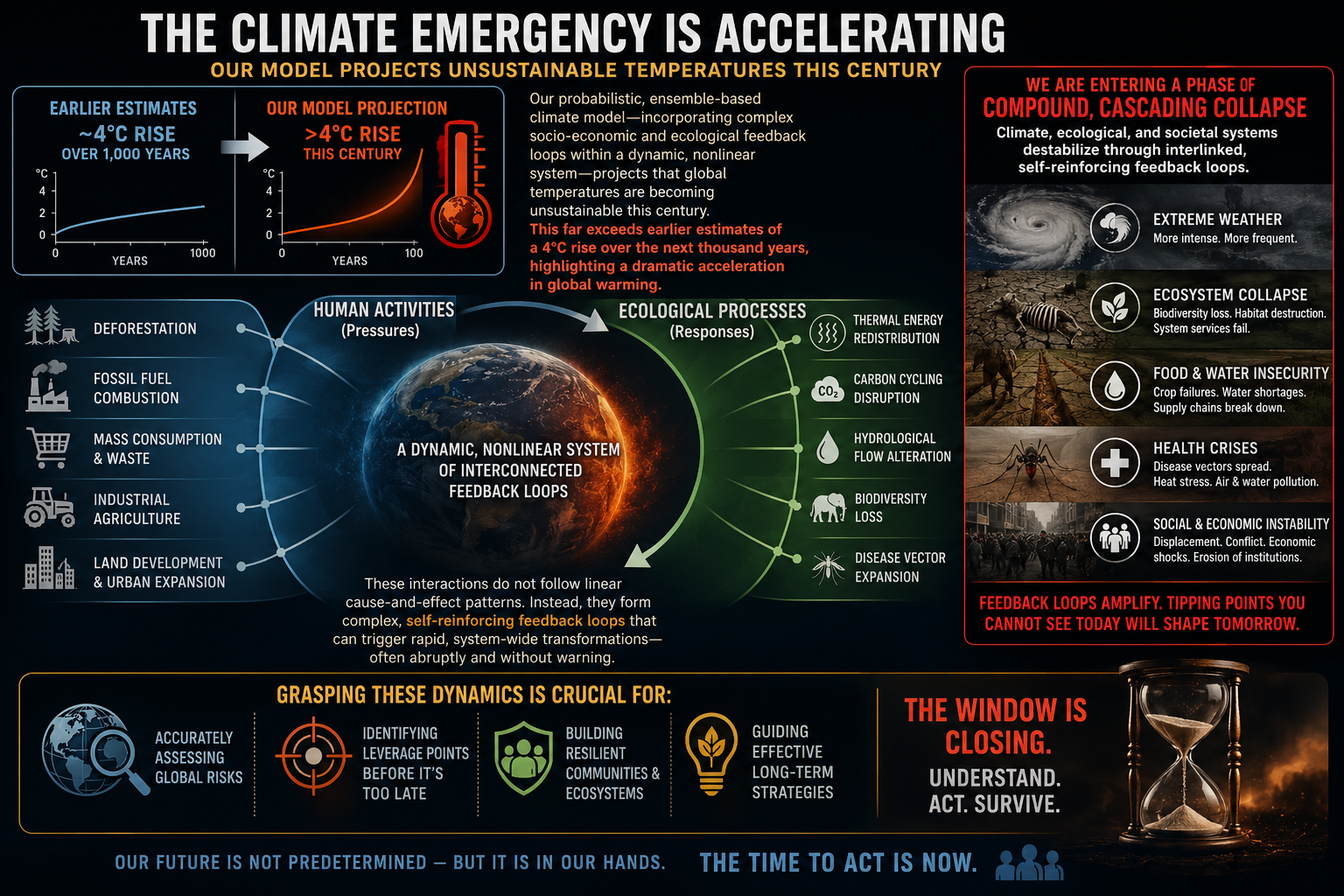
* Our probabilistic, ensemble-based climate model — which incorporates complex socio-economic and ecological feedback loops within a dynamic, nonlinear system — projects that global temperatures are becoming unsustainable this century. This far exceeds earlier estimates of a 4°C rise over the next thousand years, highlighting a dramatic acceleration in global warming. We are now entering a phase of compound, cascading collapse, where climate, ecological, and societal systems destabilize through interlinked, self-reinforcing feedback loops.
We examine how human activities — such as deforestation, fossil fuel combustion, mass consumption, industrial agriculture, and land development — interact with ecological processes like thermal energy redistribution, carbon cycling, hydrological flow, biodiversity loss, and the spread of disease vectors. These interactions do not follow linear cause-and-effect patterns. Instead, they form complex, self-reinforcing feedback loops that can trigger rapid, system-wide transformations — often abruptly and without warning. Grasping these dynamics is crucial for accurately assessing global risks and developing effective strategies for long-term survival.
Bottom line: The question is no longer how warm the planet becomes, but how life on Earth can endure when change outpaces our ability to adapt.
We cannot control the laws of physics, but we can control our pollution. The most effective action is to stop burning fossil fuels.