By Daniel Brouse
What is a Corsi-Rosenthal Box and how do you build one? The Corsi-Rosenthal Box is a simple DIY air filter and purifier that outperforms and can be more effective than expensive HEPA purifiers.
Corsi-Rosenthal Boxes are made from cardboard, tape, furnace air filters, and a box fan.
The Corsi-Rosenthal Box was invented by Richard Corsi, PhD, of the University of California-Davis and Jim Rosenthal, CEO of Tex-Air Filters.
"One night, I just scribbled out this idea on a piece of paper," said Corsi. "It wasn't an original idea people had put a single filter on a box fan before. But not with MERV 13 filters." (MERV -- minimum efficiency reporting values -- is the measure of how well a filter captures particles. The higher the MERV, the more effective the filter.)
"The Corsi-Rosenthal box outperformed the HEPA filter on every sized particle," Rosenthal said. "You have such high flow from these fans, way more flow than you get out of a commercial HEPA filter. The air goes through the filter more than once in the same period of time. It may only get 50% of the particles at first. But the second time through, it's getting much more."
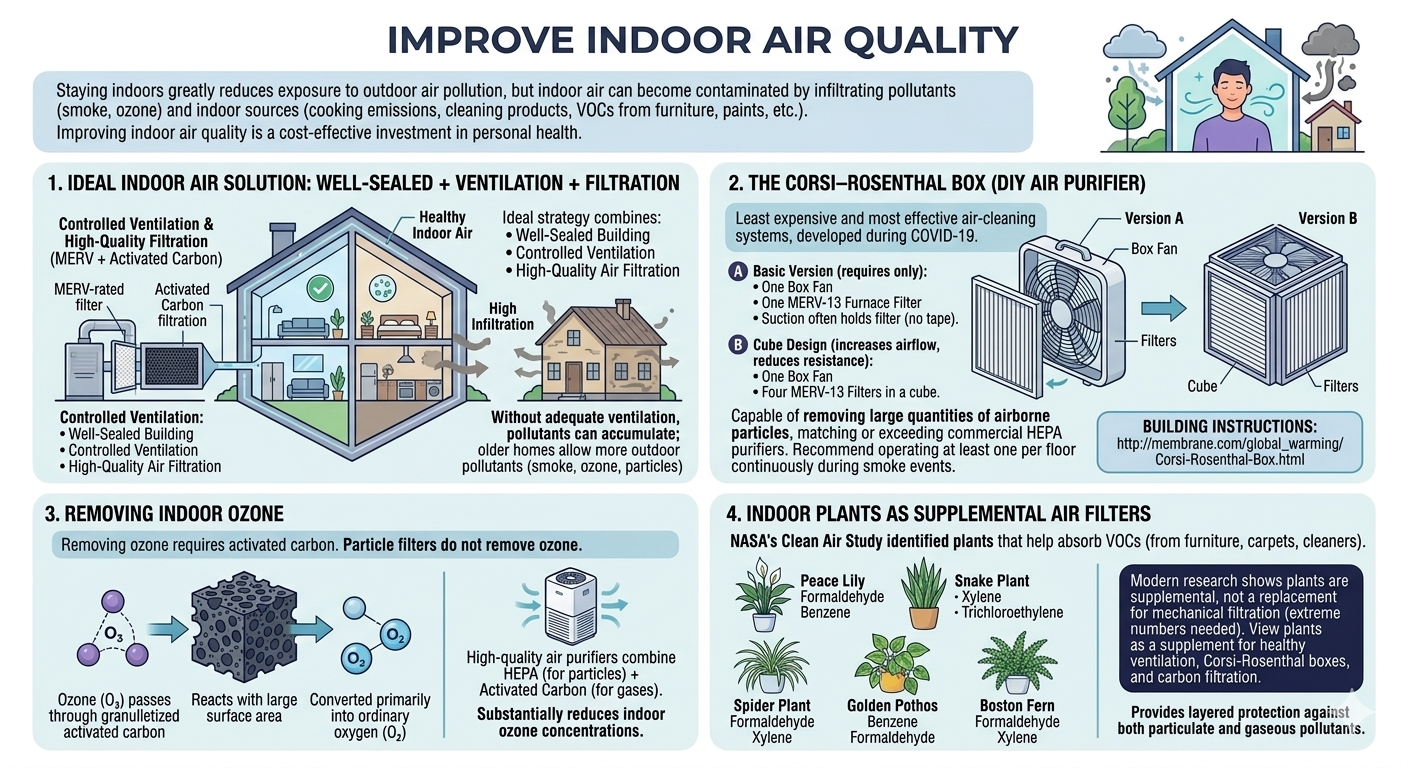
One of the cheapest and most energy-efficient methods for improving indoor air quality and household climate resilience is the Corsi–Rosenthal Box.
The Corsi–Rosenthal Box is a simple DIY air filtration system that can outperform many expensive commercial HEPA purifiers at a fraction of the cost.
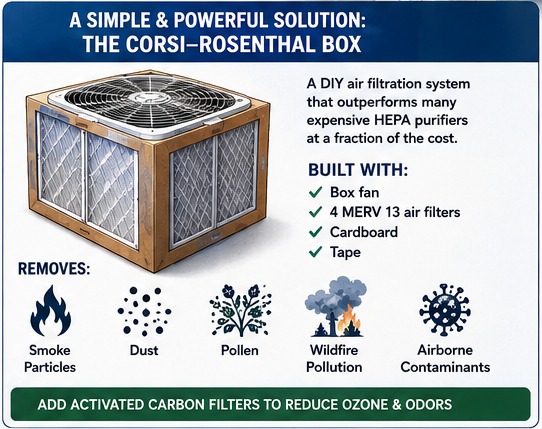
It is built using:
The design improves air circulation while removing:
All you need is a box fan and some furnace filters. You can start with just one filter placed behind the fan; you don’t even need tape because the fan’s suction holds the filter securely in place.
Important: Upgrade your air filtration system. To effectively remove indoor ozone, granular or pelletized activated carbon filters are the best choice. Standard particulate filters—including fiberglass and HEPA filters—are designed to capture airborne particles, not gases, and therefore do not remove ozone. Activated carbon works differently: as ozone (O3) passes through the carbon media, it reacts with the carbon surface and is converted primarily into ordinary oxygen (O2), significantly reducing indoor ozone concentrations.
Corsi-Rosenthal Box TestSmoke from wildfires in Canada brought record-breaking air pollution to the United States this spring, creating dangerous air quality from Bismarck, N.D., to Denver and Detroit to New York City and Washington. According to a Washington Post analysis of smoke data through June 7 (2023) from Stanford University, 197 air quality monitoring stations have reported all-time high pollution from wildfires.During the Air Quality Crisis of 2023 the plant-based long-term breathing experiment failed the test. After 4 days in a row of Unhealthy (151 to 200 AQI) to Hazardous (301 and higher AQI) outdoor air quality, the the plant-filtered indoor air quality was unhealthy.
Even with spider plant filled windows and dozens of other plants, humans still suffered from itchy eyes, scratchy throats, and headaches.
Christopher suggested, "You should look into Corsi-Rosenthal... they consistently outperform high-end air filtration systems and it's a simple DIY project."
Sidd independently advised, "We are way beyond that (plant filtration). Put in something about Corsi-Rosenthal filters and CO2 monitors to judge ventilation.
Sooo... luckily I had a couple furnace filters, a box fan, and a case of beer. After constructing a crude Corsi-Rosenthal Box, the entire first floor was cleared of noticeable pollutants within 15 minutes. The itchy eyes, scratchy throat, and headache dissipated.

To confirm our results, we brought in the hound dog. Dogs are even more sensitive to air quality. After days of suffering in unhealthy air quality, the hound immediately laid down with his nose in the flow of the circulating Corsi-Rosenthal filtered air.
Conclusion
Air quality is already considered the number one contributing factor to death worldwide. Climate change is making poor air quality even more extreme. A combination of plant and Corsi-Rosenthal filtered air is recommended on a daily basis.
Our experiment was conducted in Southeastern Pennsylvania during an extreme air quality event; however, to our east is Philadelphia. The immediate Philadelphia area rarely has a day of Good air quality. Most summer days are Moderate to Very Unhealthy. To our west is Morgantown and Lancaster County. Even though Lancaster is a much more rural area, it continuously has some of the worst air quality in the world. So it doesn't really matter where you live, implementing plant and Corsi-Rosenthal filtered air to the daily routine will likely improve your quality and quantity of life.
Breathing in Danger: The Health Crisis of Air Pollution and How to Protect Yourself
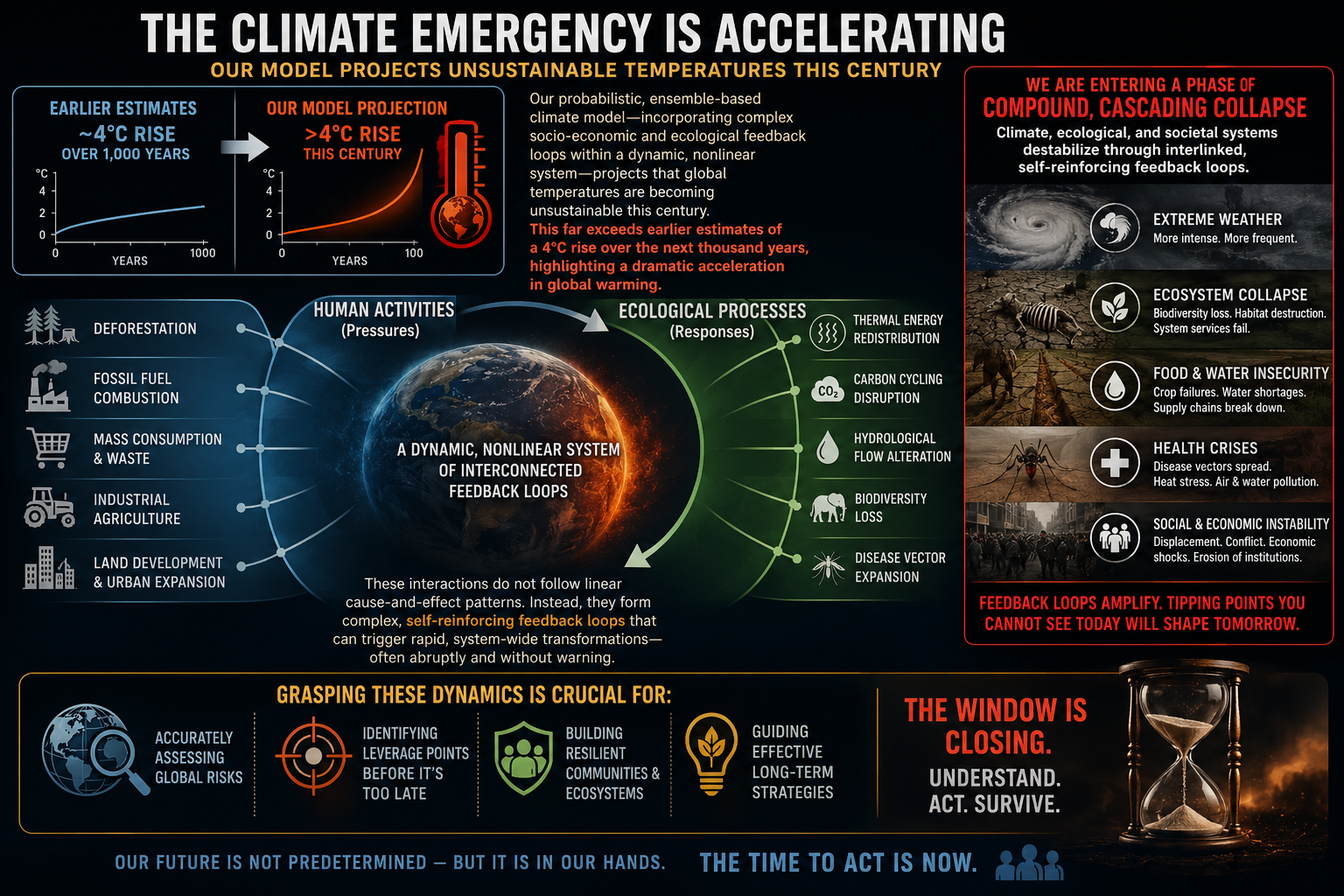
* Our probabilistic, ensemble-based climate model — which incorporates complex socio-economic and ecological feedback loops within a dynamic, nonlinear system — projects that global temperatures are becoming unsustainable this century. This far exceeds earlier estimates of a 4°C rise over the next thousand years, highlighting a dramatic acceleration in global warming. We are now entering a phase of compound, cascading collapse, where climate, ecological, and societal systems destabilize through interlinked, self-reinforcing feedback loops.
We examine how human activities — such as deforestation, fossil fuel combustion, mass consumption, industrial agriculture, and land development — interact with ecological processes like thermal energy redistribution, carbon cycling, hydrological flow, biodiversity loss, and the spread of disease vectors. These interactions do not follow linear cause-and-effect patterns. Instead, they form complex, self-reinforcing feedback loops that can trigger rapid, system-wide transformations — often abruptly and without warning. Grasping these dynamics is crucial for accurately assessing global risks and developing effective strategies for long-term survival.
Bottom line: The question is no longer how warm the planet becomes, but how life on Earth can endure when change outpaces our ability to adapt.
We cannot control the laws of physics, but we can control our pollution. The most effective action is to stop burning fossil fuels.