How Is the Climate Energy Hitting You?
Backyard Megapitfall Traps
A backyard pool can unintentionally become a giant ecological trap—and an unexpected biological sensor.
🪱 Earthworms increase after extreme rainfall. 🐛 Millipedes emerge during flash droughts and extreme evaporation. 🕷️ Water-walking spiders are increasing, potentially responding to greater prey availability.
🐸 And the most striking change? The frogs have disappeared.
Public Access Introduction
🌎 HOW IS CLIMATE ENERGY HITTING YOU?
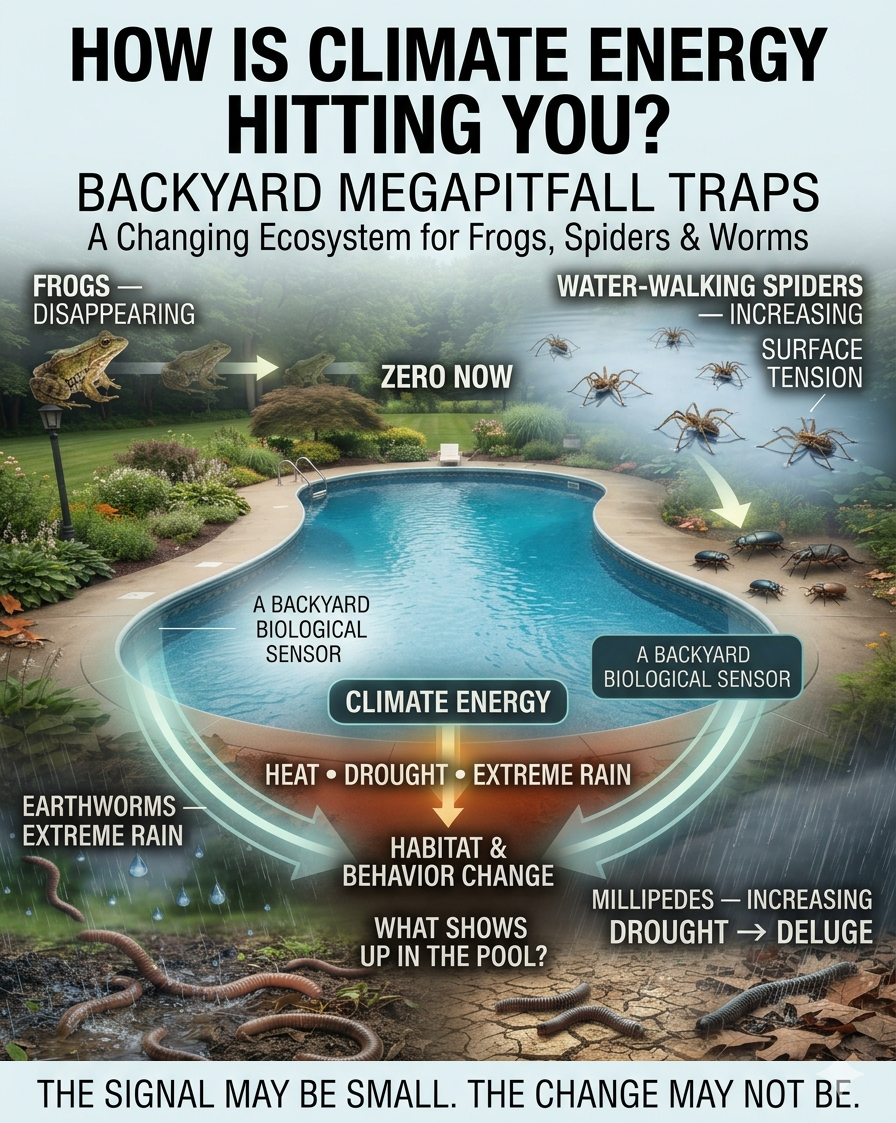
🏊 Backyard Megapitfall Traps: A Changing Ecosystem for Frogs, Spiders & Worms
What can a swimming pool tell us about climate change?
More than you might think.
A backyard pool can unintentionally become a giant ecological trap—and an unexpected biological sensor.
🪱 Earthworms increase after extreme rainfall.
🐛 Millipedes emerge during flash droughts and extreme evaporation.
🕷️ Water-walking spiders are increasing, potentially responding to greater prey availability.
🐸 And the most striking change?
The frogs have disappeared.
What was once a regular cycle of frog rescues and deaths has declined to zero frogs in the pool.
That doesn’t mean a backyard pool can prove climate causation. But it can reveal something important: ecological change leaves fingerprints.
Heat. Drought. Extreme rainfall. Evaporation. Habitat stress. Changing food webs.
These forces don’t remain somewhere far away in a climate model. They reach the backyard.
🌡️ Climate energy → weather extremes → habitat changes → animal behavior → changing wildlife
The pool is small.
The creatures are small.
But the ecological signal may not be.
🔎 Sometimes the first signs of a changing planet are right in your own backyard.
The Experiment
Backyard Megapitfall Traps: A Changing Ecosystem for Frogs, Spiders, and Worms
A swimming pool can unintentionally function as a giant megapitfall trap—an ecological trap that collects animals from the surrounding landscape. What falls into the pool, what survives, and what disappears can provide a surprisingly revealing snapshot of changes taking place in the local ecosystem.
Detection Surveys: Using Pools as Wildlife Traps
When scientists deliberately examine swimming pools to sample local wildlife or detect invasive species, the practice can be described as a swimming-pool detection survey. Because pools are already constructed, filled with water, and often surrounded by terrestrial habitat, they can serve as convenient passive sampling sites for studying urban and suburban biodiversity.
A backyard observation project in southeastern Pennsylvania has produced several striking changes over the past several years. Although a single backyard pool is not a controlled scientific experiment, the patterns are sufficiently noticeable to raise important questions about how changing temperature, precipitation, drought, and habitat conditions may be affecting local wildlife.
1. More Earthworms After Extreme Rainfall
Earthworms have become noticeably more common in the pool following intense rainfall events.
During heavy rain, saturated soils can force earthworms toward the surface. Flash flooding and rapid changes in soil moisture can then transport them across lawns and other surfaces, increasing the likelihood that they end up in the pool.
The connection to hydroclimatic whiplash—rapid swings between very wet and very dry conditions—is particularly interesting. Increasingly erratic precipitation can produce conditions in which soils cycle rapidly between saturation and drying, potentially altering earthworm movement and survival.
2. More Millipedes During Dry and Wet Extremes
Millipedes have also become more noticeable.
During dry periods, extreme evaporation and declining soil moisture can drive millipedes out of their preferred moist environments in search of shelter and water. When intense rainfall follows a period of drought, the resulting rapid change in soil conditions can further disrupt their normal movement patterns.
This combination of flash drought, extreme evaporation, and intense rainfall is another example of hydroclimatic whiplash affecting even the smallest components of the backyard ecosystem.
3. Water-Walking Spiders: An Unexpected Increase
Perhaps the most intriguing observation is not the number of dead spiders in the pool, but the increasing number of living, water-walking spiders.
Many terrestrial animals—voles, earthworms, beetles, and other insects—fall into the pool accidentally and eventually drown. Water-walking spiders are different. Their hydrophobic bodies and specialized legs allow them to exploit the water surface rather than simply becoming victims of the trap.
The pool can therefore function as an intentional hunting ground rather than an accidental death trap.
Surface tension provides the physical mechanism. The spider’s lightweight body and water-repellent structures allow it to distribute its weight across the water surface without breaking through. Rather than being trapped by the pool, these spiders can use it as habitat.
The noticeable increase in water-walking spiders may reflect several factors, including increased prey availability. This observation coincides with a noticeable increase in beetle activity and other potential food sources around the pool. However, despite the increase in beetle activity, there has not been a corresponding increase in beetle carcasses in the pool. One possible explanation is that the growing spider population is consuming more of the available prey before it accumulates as dead insects in the trap. While this remains a hypothesis, the simultaneous increase in spiders and apparent reduction in prey carcasses is an intriguing pattern worth further observation.
4. The Most Striking Change: Where Are the Frogs?
The most dramatic change in this backyard megapitfall record is the disappearance of frogs.
Frog rescues—and frog deaths—were once common occurrences. Over the past several years, however, the number has steadily declined until there have been zero frogs in the pool.
That does not, by itself, establish that climate change caused a local frog disappearance. But it is a striking observation because amphibians are among the world’s most threatened groups of vertebrates, and they are exceptionally sensitive to changes in temperature, moisture, disease, habitat, and water availability.
The disappearance of frogs from one backyard may therefore be worth viewing as a potential local ecological signal rather than simply an absence of frogs in a swimming pool.
Why Are Amphibians So Vulnerable?
Climate change can interact with multiple stresses that already affect amphibians. Four mechanisms are particularly important.
1. Loss and Drying of Breeding Ponds
Many frogs depend on temporary wetlands, vernal pools, shallow ponds, ditches, and other small bodies of water for reproduction.
Changes in precipitation, warmer temperatures, and increased evaporation can cause these habitats to dry earlier. If breeding pools disappear before tadpoles complete metamorphosis, an entire reproductive season can fail.
Repeated failures over several years can eventually eliminate a local population.
2. Terrestrial Dehydration
Frogs have highly permeable skin and depend on moist environments to maintain water balance.
During periods of extreme heat and drought, the landscape between a frog’s refuge and a backyard pool can become increasingly hostile. Hot lawns, dry soil, pavement, and other impervious surfaces can create barriers that frogs cannot safely cross.
Unlike a water-walking spider, a frog cannot simply tolerate prolonged exposure to a dry, overheated landscape.
3. Disease and Chytrid Fungus
Climate and weather can also interact with infectious disease.
Batrachochytrium dendrobatidis (Bd), commonly known as chytrid fungus, infects amphibian skin and has contributed to severe population declines and extinctions around the world.
The relationship between climate and chytrid disease is complex. Temperature and moisture conditions can influence pathogen growth, transmission, and host susceptibility. Climate change can therefore alter the geographic and seasonal conditions under which amphibian diseases spread.
4. Urbanization and Habitat Fragmentation
Climate stress does not occur in isolation.
Suburban development fragments forests, wetlands, and other amphibian habitat into increasingly isolated patches. A small local population may have nowhere to go when drought, extreme heat, disease, or another disturbance strikes.
Once a population disappears from an isolated habitat fragment, recolonization may be difficult or impossible.
A Backyard Window Into a Larger System
The swimming pool is not a climate instrument. It cannot tell us, by itself, why one species increases while another disappears.
But it can function as an unexpected biological sensor.
The pool collects organisms moving through the surrounding environment. Changes in what appears in the water—and what no longer appears—may reflect changes occurring beyond the pool itself.
Earthworms responding to extreme rainfall.
Millipedes responding to drying soils and sudden moisture.
Water-walking spiders exploiting a changing surface environment.
And frogs disappearing altogether.
These observations raise a larger question:
What happens when the energy entering the climate system is redistributed through the biological system?
Climate change does not arrive in our backyards as an abstract global average temperature. It arrives through altered rainfall, flash floods, drought, evaporation, heat, disease, habitat stress, and changing interactions among species.
Sometimes the evidence is visible in a satellite image.
Sometimes it is recorded by a weather station.
And sometimes, surprisingly, it is floating in your swimming pool.
Expert Perspective
The broader amphibian decline is well documented. The U.S. Geological Survey has reported substantial long-term declines in amphibian populations and has highlighted the vulnerability of amphibians to increasing heat and declining water availability.
One USGS analysis estimated an average annual decline in amphibian abundance of approximately 3.8% per year, with continued declines potentially causing species to disappear from large portions of their former ranges.
The lesson from the backyard pool is not that every ecological change can be pinned on climate change. The lesson is that ecological change leaves fingerprints—and sometimes those fingerprints appear in places we never thought to look.
What enters the trap matters. What survives matters. And what suddenly stops appearing may matter most of all.
The increase in earthworms following extreme rainfall, the surge of millipedes during swings between drought and deluge, the growing presence of water-walking spiders, and the disappearance of frogs are not isolated curiosities. Together, they form a changing biological pattern—a small, local record of a system under stress.
The backyard pool may therefore be more than a place where wildlife accidentally dies.
It may be a biological window into a changing climate.
A swimming pool is tiny compared with the planetary climate system. But climate change is not experienced as a planetary abstraction. It is expressed locally—in the soil, in the water, in insects and spiders, in amphibians, and in the species that suddenly become common or disappear altogether.
The megapitfall trap is small. The signal may not be.
What is happening in this backyard may be one tiny piece of a much larger planetary experiment—one that is already unfolding around us.
Backyard Experiments
How Is the Climate Energy Hitting You? is a collection of backyard experiments conducted in conjunction with you—the reader. The goal is simple: to look at how the increased energy in the climate system is showing up in our everyday lives.
Is it becoming more extreme, more frequent, and more persistent? Are the changes becoming stranger—or even disturbing?
- Philadelphia and Southeastern PA: Heatwaves, Severe Storms, Flash Floods, Flash Droughts, Extreme Winds, Microbursts, Tornadoes
- Penn's Sylvania: Ecosystem Conversion, Vapor Pressure Deficit (VPD), Transpiration, Hydroclimatic Whiplash
- West Chester, Pennsylvania: Hydroclimatic Whiplash and Urban Flooding — Unfortunately, Worms Can't Swim
- West Chester, Pennsylvania: Hydroclimatic Whiplash and Flash Droughts — Unfortunately, Millipedes Can't Swim
- The Backyard Experiments: Hydroclimatic Whiplash, Soil Degradation, Insect Decline, and Ecosystem Collapse
Taking the Temperature of Climate Change: How Is Climate Energy Hitting You?
Easy-to-Read Resources