How Is the Climate Energy Hitting You?
Pennsylvania: When the Levee Breaks
Atmospheric warming → extreme precipitation → flooding → infrastructure stress → levee vulnerability → insurance risk → property values → household finances → municipal finances
When the Levee Breaks — Crying Won’t Help You, Praying Won’t Do You No Good
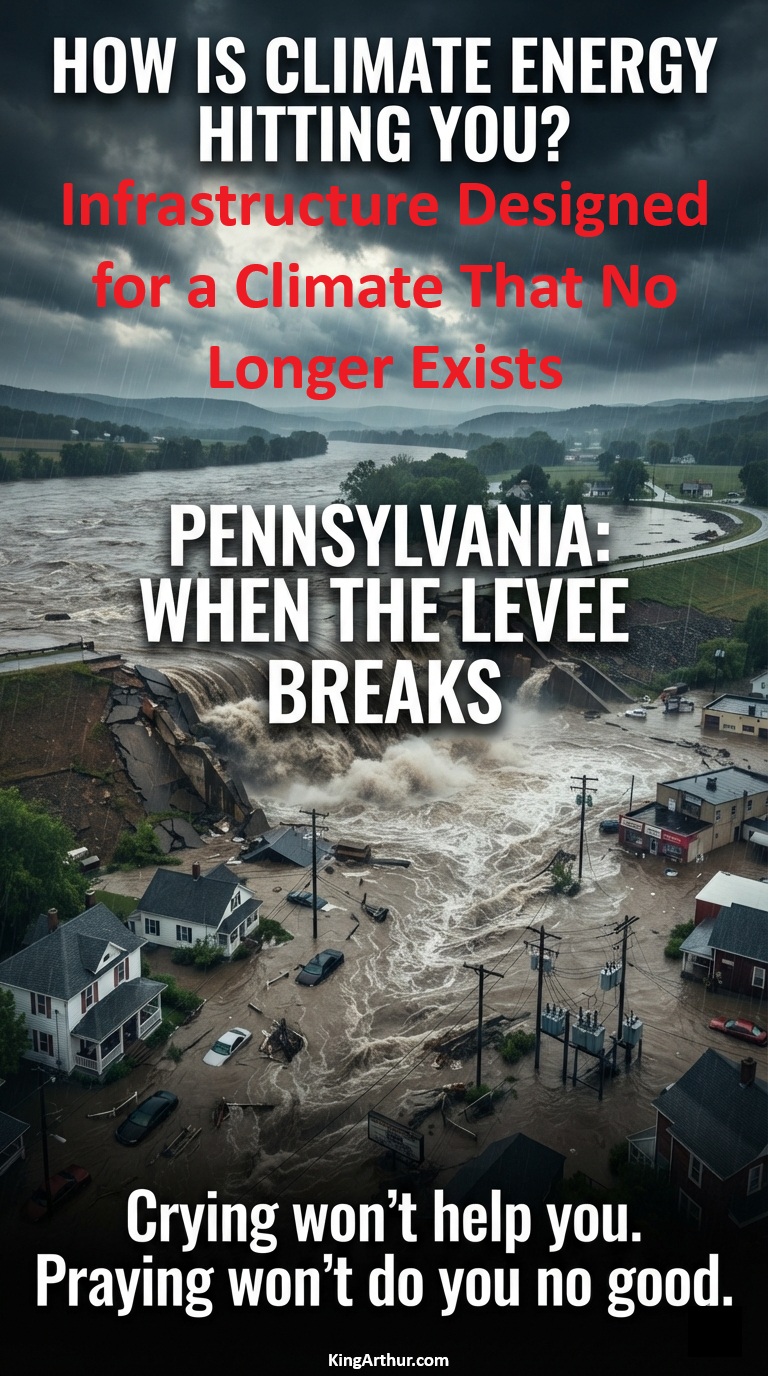
Pennsylvania’s aging levees reveal a dangerous mismatch between a rapidly changing climate-energy system and infrastructure designed for a climate that no longer exists.
The problem is much larger than flooding. It is a collision between increasing hydrological energy, aging infrastructure, growing exposure, declining safety margins, and inadequate funding. Together, these forces can create nonlinear risk: conditions may deteriorate gradually for years, followed by an abrupt failure when a sufficiently powerful event exceeds the system’s remaining capacity.
Climate Energy Becomes Hydraulic Energy
A warming atmosphere does not simply produce higher temperatures. It changes the amount and distribution of energy available to the hydrological cycle.
Warmer air can hold substantially more water vapor, increasing the potential for extreme precipitation. When that moisture is released, the resulting rainfall can rapidly transfer enormous amounts of atmospheric energy into rivers, streams, drainage systems, dams, levees, roads, homes, and other infrastructure.
A levee does not care about the average temperature. It is dependent on how much water arrives, how quickly it arrives, how high the river rises, how rapidly water flows, how long the pressure persists, and whether the resulting forces exceed the structure’s design and remaining safety margin.
This creates a critical distinction:
Climate change is not merely making Pennsylvania warmer. It is increasing the energy available to produce extreme hydrological events—and that energy is ultimately transferred into the physical systems protecting human communities.
Aging Infrastructure Creates a Declining Safety Margin
Pennsylvania has more than 180 levees extending roughly 155 miles and protecting approximately 158,000 people and $26.2 billion in property. Many of these structures were constructed between the 1950s and 1970s. Much of this infrastructure is therefore now six to eight decades old.
Age alone does not mean that a levee will fail. But aging infrastructure generally requires increasing maintenance, inspection, rehabilitation, and investment to preserve its original level of protection.
At the same time, the environment in which these structures operate is changing.
That creates a fundamental systems problem:
Increasing climate energy + aging infrastructure = declining safety margin.
A levee may continue functioning normally for decades while its underlying vulnerability steadily increases. Then a sufficiently extreme event can cross a threshold and produce overtopping, erosion, seepage, internal piping, foundation failure, or structural collapse.
The failure therefore may appear sudden even though the vulnerability accumulated gradually.
The Nonlinear Risk of Threshold Failure
This is a classic threshold process.
The sequence can be represented as:
Increasing warming → more atmospheric moisture → heavier precipitation → greater runoff → greater river energy → increasing levee stress → shrinking safety margin → threshold exceedance → failure
The critical point is that the consequences do not necessarily increase proportionally with the forcing. A modest increase in flood energy may produce little visible difference when a levee has substantial reserve capacity. But once the remaining safety margin becomes small, a relatively small additional increase in flood energy can produce a disproportionately large change in outcome.
That is how a system can move from:
Protected → stressed → overtopped → breached → flooded
in a matter of hours.
Exposure Makes the Consequences Larger
The problem is compounded by what exists behind the levees. Communities have invested homes, businesses, roads, utilities, water systems, industrial facilities, transportation networks, and billions of dollars of property in areas protected by these structures. The levee therefore does more than hold back water. It establishes a boundary between climate-driven flood energy and human civilization. As development accumulates behind that boundary, the consequences of failure increase.
This produces another dangerous relationship:
More extreme flooding + more people and property at risk + aging protection = increasing consequences
The flood hazard does not have to become catastrophic for the consequences to become catastrophic.
The vulnerability of the protected system can amplify the impact.
Funding Becomes Part of the Climate Feedback
Infrastructure deterioration is not simply an engineering problem. It can become a feedback mechanism. Levees require continual maintenance. Erosion must be repaired. Vegetation and animal damage must be controlled. Drainage systems, pumps, pipes, floodwalls, foundations, and embankments must be inspected and maintained. Yet the financial responsibility for these systems is fragmented, and many communities lack the resources necessary to address increasingly expensive infrastructure requirements.
This creates a potentially self-reinforcing cycle:
More extreme weather → more infrastructure damage → greater repair costs → inadequate funding → deteriorating infrastructure → greater vulnerability → greater future damage
The result is a positive feedback loop in which climate impacts increase the cost of maintaining the very infrastructure needed to withstand those impacts. And every major flood can further reduce the resources available for preparing for the next one.
Insurance and Property Values Become Secondary Pathways
The consequences can also propagate far beyond the levee itself. When flood protection becomes questionable, communities can face increased regulatory, insurance, financing, and development pressures.
That means climate energy can travel through an unexpectedly long chain of systems:
Atmospheric warming → extreme precipitation → flooding → infrastructure stress → levee vulnerability → insurance risk → property values → household finances → municipal finances
The climate impact therefore doesn’t end when the rain stops. Its economic consequences can continue for years.
Pennsylvania Has Already Seen the Warning
Pennsylvania does not have to wait for some distant future to experience these dynamics. Extreme rainfall events have already produced extraordinary flooding throughout the state and the broader Northeast. During Hurricane Ida in 2021, portions of Southeastern Pennsylvania received several inches of rain in a matter of hours, while rivers rapidly approached or exceeded dangerous flood stages. Events like this demonstrate an important characteristic of climate risk:
The critical variable is not simply how much precipitation falls over an entire year.
It is increasingly about how much water arrives at once.
A community can survive a large amount of annual precipitation when it is distributed over time. The same amount concentrated into a few hours can overwhelm drainage systems, rivers, roads, bridges, wastewater facilities, and flood defenses.
The climate system is therefore changing not only the quantity of water but potentially its timing, intensity, concentration, and destructive power.
The Levee Is a Climate Barrier
The deeper lesson is that a levee is effectively a temporary barrier between Earth-system energy and human systems. The atmosphere stores moisture. Storm systems transport energy. Rain releases that energy. Rivers concentrate it. Floodwaters transmit it. Infrastructure absorbs it. Human communities ultimately pay the bill.
That is the meaning of How Is Climate Energy Hitting You?
Climate energy does not remain an abstract measurement in the atmosphere.
It becomes water pressure against a levee.
It becomes a flooded basement.
It becomes a destroyed road.
It becomes a damaged bridge.
It becomes an insurance claim.
It becomes a municipal repair bill.
It becomes lost property value.
And when the protective barrier finally reaches its threshold, the transition from protection to destruction can be extraordinarily rapid.
The Coming Problem Is Not Simply More Flooding
Pennsylvania’s levee problem illustrates a much larger climate phenomenon.
The danger is the interaction of multiple changing systems:
Climate energy is increasing.
Extreme precipitation is intensifying.
Infrastructure is aging.
Exposure is growing.
Safety margins are shrinking.
Maintenance costs are increasing.
Funding remains limited.
Each problem reinforces the others. This is why climate risk should not be evaluated solely through changes in average temperature.
The more important question is:
What happens when millions of interconnected physical, ecological, economic, and human systems respond simultaneously to increasing energy?
A levee failure provides a remarkably clear example. The levee may hold. Until it doesn’t. And when the levee breaks, crying won’t help you. Praying won’t do you no good.
Because the water is carrying the energy of a changing climate straight through the barrier society built to keep it out.
How Is Climate Energy Hitting You?
Taking the Temperature of Climate Change: Meeting of the Minds
Easy-to-Read Resources
→ The Hitchhiker’s Guide to Climate Change
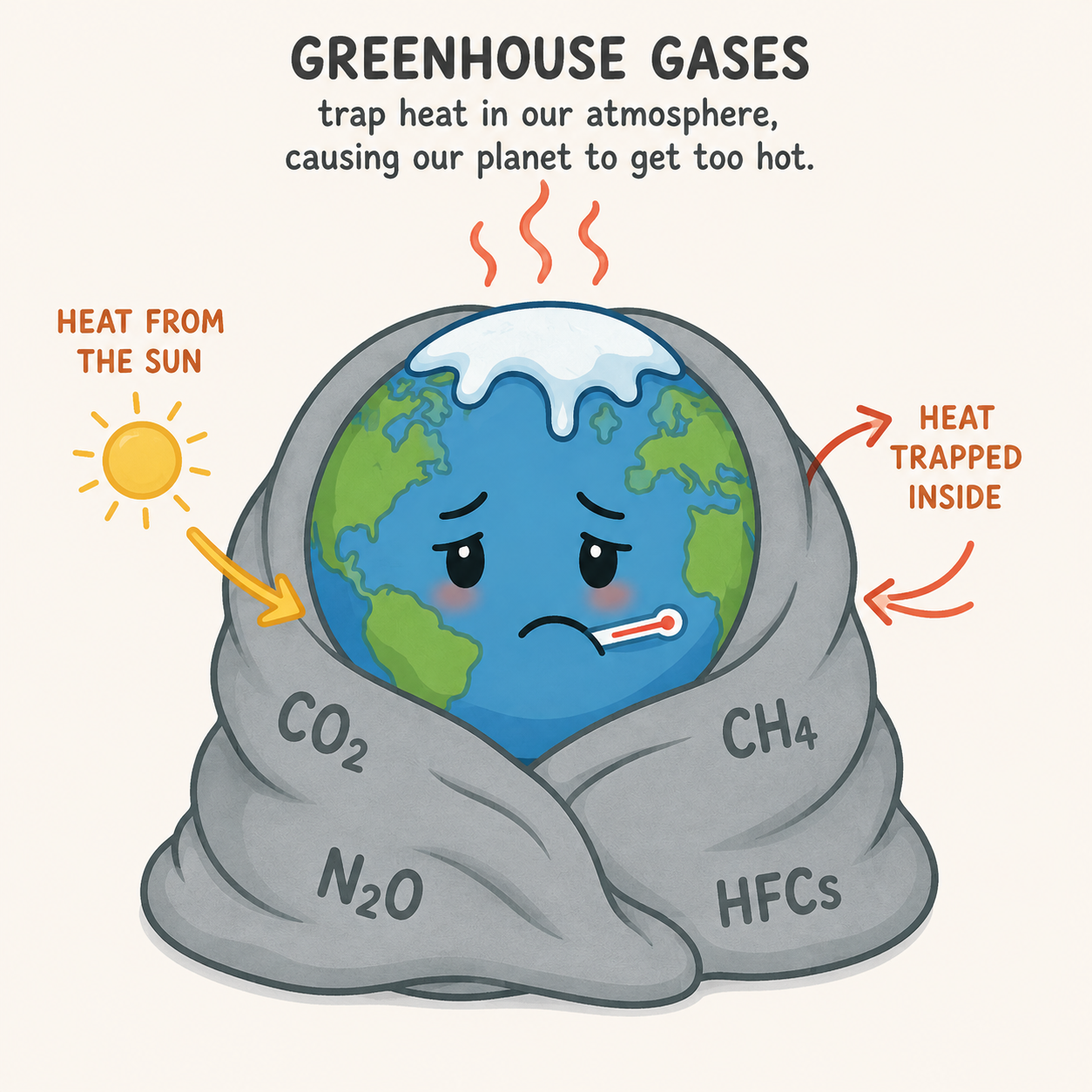
For the basics: Climate Change Simplified
Climate Change: What Can I Do?
Anthropogenic Global Warming 101
Feedback Loops →
Tipping Points →
Acceleration →
Domino Effect
Feedback loops amplify climate change and can push interconnected Earth systems past critical tipping points. As tipping points are crossed, they can trigger additional feedback loops and destabilize other climate systems. This cascading "Domino Effect" compresses timescales, accelerates change, and increases the risk of rapid, nonlinear climate transformations.