by Daniel Brouse
July 2026
Climate change is not a simple chain of cause and effect. The Earth operates as a connected system where changes in one part of the planet can trigger responses in many others. These emerging coupled feedback interactions demonstrate a fundamental principle of nonlinear systems: a small initial change can spread through multiple connected processes and produce a response much larger than the original disturbance. This is the climate version of the Butterfly Effect.
Multiple climate indicators now point to rates of warming-related disruption far beyond those observed during the modern instrumental era. There is no well-established geological analog for a sustained, multi-variable, decade-scale pattern of accelerating change across the full Earth system at the resolution available in contemporary observations. If sustained, this may represent one of the most abrupt large-scale climate transitions in Earth’s geological history.
Many of the climate indicators traditionally used for forecasting are exhibiting increasingly nonlinear and volatile behavior. Temperature anomalies, ocean heat content, sea-level rise, atmospheric moisture, ice loss, and extreme weather patterns are showing changes that are becoming more difficult to model using assumptions based primarily on historical variability.
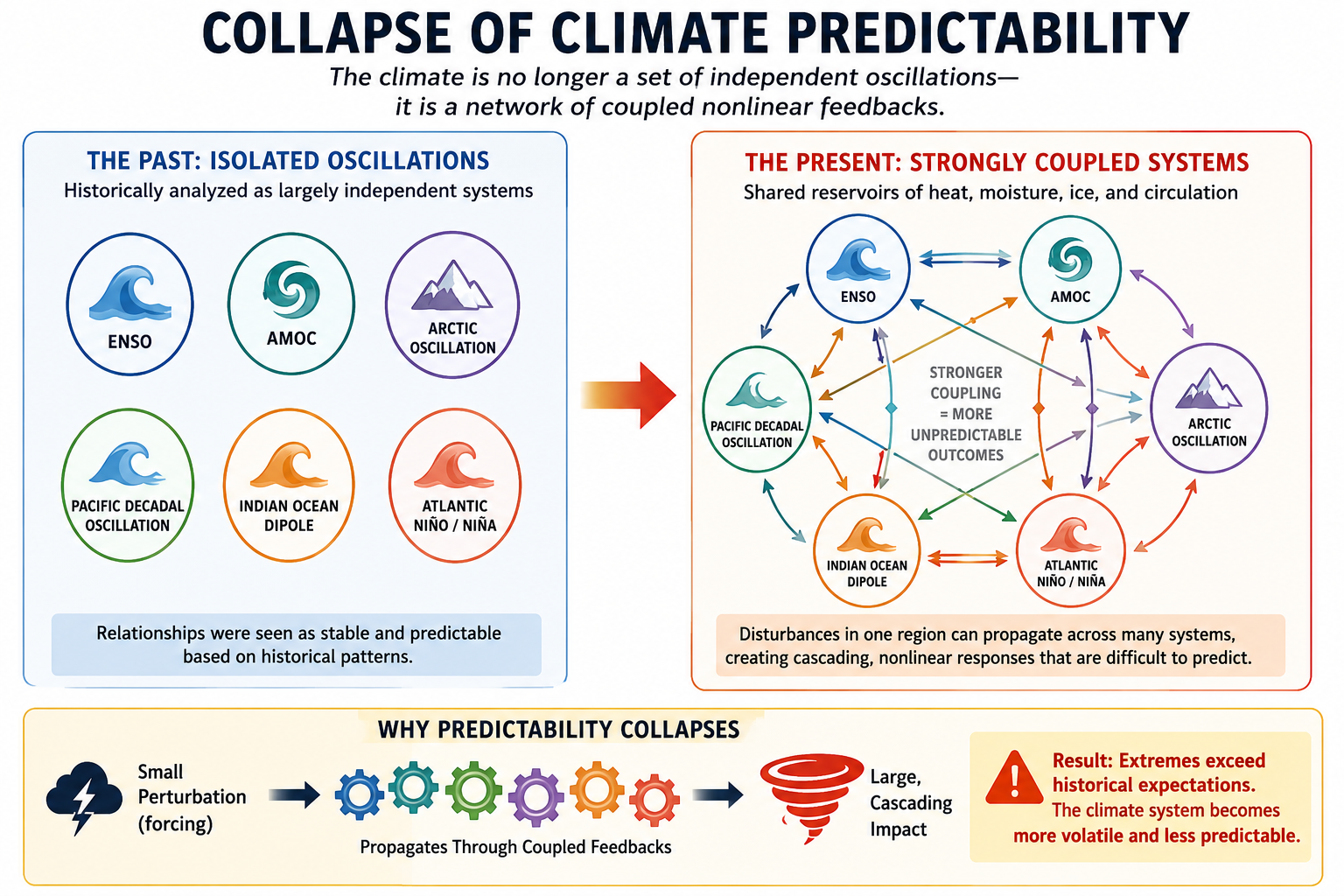
For much of the modern scientific era, Earth’s major climate oscillations were studied as largely independent systems. Phenomena such as the El Niño–Southern Oscillation (ENSO), the Atlantic Meridional Overturning Circulation (AMOC), the Arctic Oscillation (AO), the Pacific Decadal Oscillation (PDO), the Indian Ocean Dipole (IOD), and the Atlantic Niño/Niña each possessed recognizable patterns, historical relationships, and reasonably predictable behavior.
Today, however, a growing body of observations suggests these systems are becoming increasingly interconnected through shared reservoirs of heat, moisture, ice, and atmospheric circulation. Rather than behaving as isolated oscillators, they are evolving into a tightly coupled network in which disturbances propagate across multiple components of the Earth system. This increasing connectivity reduces the reliability of historical climate relationships and contributes to what can be described as the collapse of climate predictability.
Classical climatology often treated Earth’s major modes of variability as separate oscillations whose interactions were relatively weak and occurred over well-defined time scales.
Examples include:
These oscillations remain useful conceptual tools, but they no longer appear to behave as isolated components. Instead, they increasingly exchange energy through atmospheric circulation, ocean heat transport, cryospheric change, and hydrologic feedbacks.
The climate system is transitioning from a collection of loosely connected oscillators to a highly interconnected nonlinear network.
The increasing coupling among climate systems is not random.
It is driven by a steadily increasing accumulation of heat within the Earth system.
More than 90 percent of the excess energy trapped by greenhouse gases is absorbed by the oceans. Rising ocean heat content increases evaporation, atmospheric water vapor, sea surface temperatures, and latent heat available to storms. At the same time, declining sea ice reduces Earth’s reflectivity, allowing additional solar energy to be absorbed. Melting glaciers introduce freshwater into the oceans, altering circulation patterns, while warming soils and thawing permafrost release additional greenhouse gases.
These processes all originate from the same growing energy imbalance, linking climate systems that historically behaved more independently.
Numerous examples illustrate this increasing interconnectedness.
Exceptional Pacific warming modifies atmospheric circulation, strengthening Atlantic trade winds and promoting cooling in portions of the tropical Atlantic. The altered Atlantic circulation then feeds back into global atmospheric patterns, influencing hurricane development, African rainfall, and Amazon precipitation.
Rapid Arctic warming weakens the north-south temperature gradient that maintains the polar jet stream. The resulting slower, more meandering jet stream favors persistent blocking patterns, prolonged heat domes, stalled storms, and extended droughts. Those weather extremes further accelerate Arctic warming through enhanced ice loss and wildfire activity.
Accelerated melting of the Greenland Ice Sheet introduces freshwater into the North Atlantic, reducing salinity and slowing deep-water formation. A weaker AMOC alters weather patterns across the Northern Hemisphere, changing precipitation and temperature patterns that can further influence Greenland’s mass balance.
Warmer oceans increase evaporation and atmospheric moisture. Enhanced water vapor intensifies atmospheric rivers, producing heavier precipitation while simultaneously reinforcing marine heatwaves through changes in ocean mixing and heat distribution.
Permafrost thaw releases methane and dries peatlands, increasing wildfire activity. Wildfires emit greenhouse gases and black carbon, which darkens snow and ice surfaces, accelerating melting and further warming high-latitude regions.
Forests recycle enormous quantities of moisture through evapotranspiration. As forests decline from heat, drought, or wildfire, atmospheric moisture recycling weakens, reducing rainfall and increasing drought severity, which in turn accelerates additional forest loss.
Historically, climate forecasting relied heavily on recurring relationships.
Meteorologists and climatologists could often estimate future conditions because the underlying oscillations behaved within relatively stable statistical boundaries.
As coupling strengthens, those assumptions become increasingly unreliable.
A disturbance originating in one ocean basin can now propagate through atmospheric circulation into multiple ocean basins, alter sea surface temperatures elsewhere, modify jet stream behavior, influence storm tracks, and feed back into the original disturbance.
Small changes no longer remain local.
Instead, they cascade through interconnected systems.
The result is increasing uncertainty, even while the underlying driver—Earth’s growing energy imbalance—continues to strengthen.
This transition is fundamentally a problem of nonlinear dynamics.
In linear systems:
In nonlinear systems:
As climate systems become more strongly coupled, Earth’s behavior increasingly resembles a nonlinear network rather than a collection of independent oscillators.
This is the climate-scale manifestation of the Butterfly Effect.
Once coupling strengthens sufficiently, climate events begin propagating across multiple systems.
For example:
Ocean Warming → Marine Heatwaves → Increased Evaporation → Higher Atmospheric Water Vapor → Stronger Atmospheric Rivers → Extreme Flooding → Reduced Snowpack → Earlier Runoff → Hotter Soils → Stronger Heat Domes → Additional Ocean Warming
Each step reinforces subsequent processes, creating cascading responses that are considerably larger than the original perturbation.
Many recent extreme events have exceeded expectations based on historical climate statistics.
Persistent heat domes, multi-day atmospheric rivers, marine heatwaves, rapid intensification of tropical cyclones, widespread wildfire outbreaks, and simultaneous extremes occurring across multiple continents increasingly reflect the behavior of an interconnected system rather than isolated weather anomalies.
The climate is no longer responding solely through individual oscillations.
It is responding through interactions among oscillations.
Understanding future climate risk increasingly requires moving beyond analyses that focus on individual climate modes in isolation.
Future prediction will depend on understanding:
The central scientific challenge is no longer identifying individual feedbacks, but understanding how those feedbacks interact simultaneously.
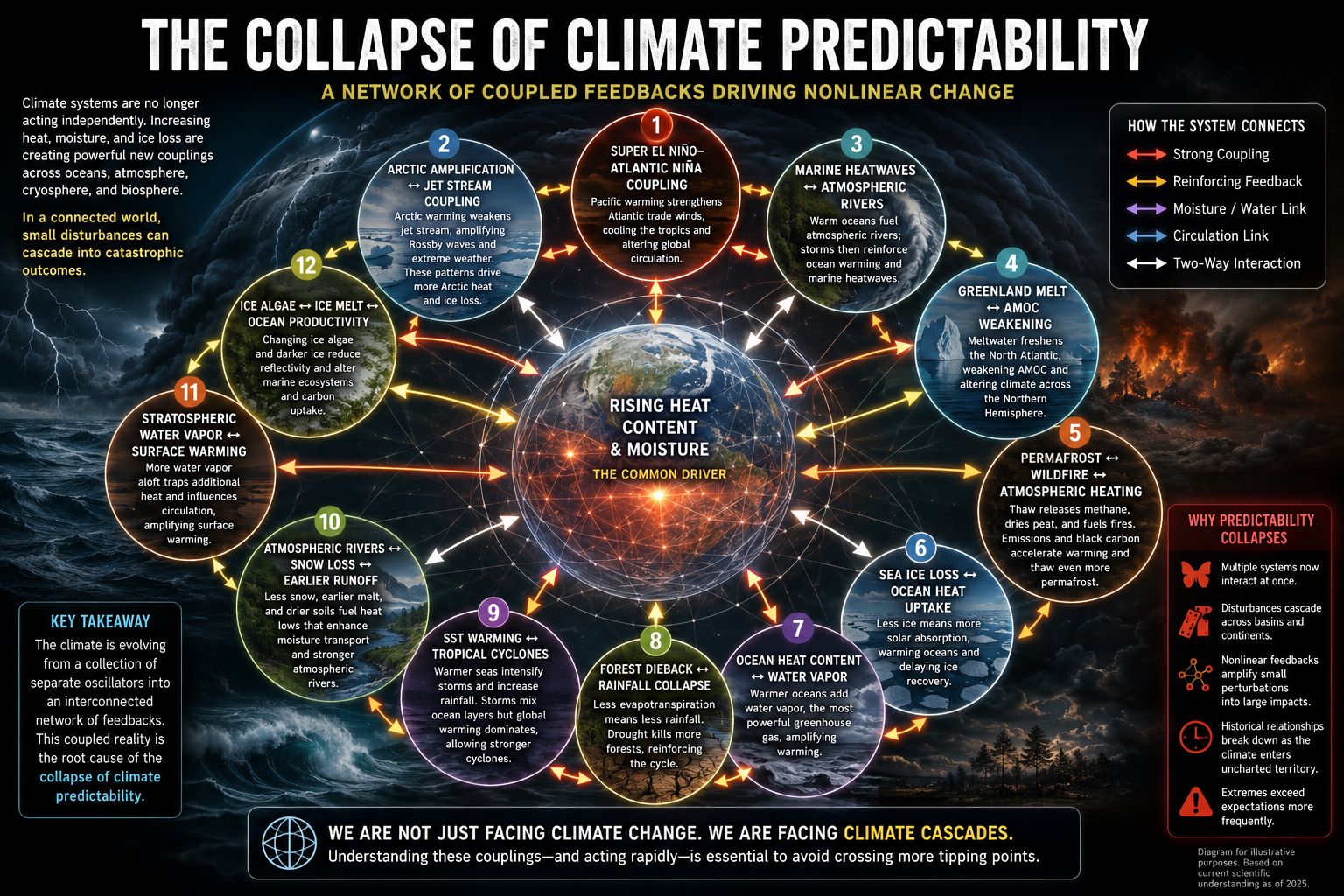
The growing accumulation of heat within Earth’s climate system is strengthening connections among atmospheric, oceanic, cryospheric, and biological processes. These interactions are transforming once largely independent climate oscillations into a coupled network of nonlinear feedbacks.
As coupling intensifies, disturbances spread more efficiently across the Earth system, historical relationships become less reliable, and extreme events increasingly exceed expectations derived from the past. The resulting decline in predictability is not evidence that the climate has become random. Rather, it reflects the behavior of a highly interconnected nonlinear system whose responses are increasingly governed by cascading interactions instead of isolated processes.
The collapse of climate predictability is therefore best understood not as the failure of climate science, but as the emergence of a new climatic regime—one in which understanding the connections between Earth’s major systems becomes as important as understanding the systems themselves.
The Strange and Hidden Feedback Network: Chaos Theory and the Acceleration of Climate Change
Beyond Degrees: Earth’s Climate History Is No Longer a Reliable Predictor of Its Future
Bottom line: The question is no longer how warm the planet becomes, but how life on Earth can endure when change outpaces our ability to adapt.
We cannot control the laws of physics, but we can control our pollution. The most effective action is to stop burning fossil fuels.
* Our probabilistic, ensemble-based climate model — which incorporates complex socio-economic and ecological feedback loops within a dynamic, nonlinear system — projects that global temperatures are becoming unsustainable this century. This far exceeds earlier estimates of a 4°C rise over the next thousand years, highlighting a dramatic acceleration in global warming. We are now entering a phase of compound, cascading collapse, where climate, ecological, and societal systems destabilize through interlinked, self-reinforcing feedback loops.
We examine how human activities — such as deforestation, fossil fuel combustion, mass consumption, industrial agriculture, and land development — interact with ecological processes like thermal energy redistribution, carbon cycling, hydrological flow, biodiversity loss, and the spread of disease vectors. These interactions do not follow linear cause-and-effect patterns. Instead, they form complex, self-reinforcing feedback loops that can trigger rapid, system-wide transformations — often abruptly and without warning. Grasping these dynamics is crucial for accurately assessing global risks and developing effective strategies for long-term survival.
Feedback Loops →
Tipping Points →
Acceleration →
Domino Effect
Feedback loops amplify climate change and can push interconnected Earth systems past critical tipping points. As tipping points are crossed, they can trigger additional feedback loops and destabilize other climate systems. This cascading "Domino Effect" compresses timescales, accelerates change, and increases the risk of rapid, nonlinear climate transformations.